- Chapter 1
Redefining Home - Chapter 2
Financial & Lifestyle Auditing - Chapter 3
The Room-by-Room Decluttering Matrix - Chapter 4
The Legacy & Gifting Strategy - Chapter 5
Estate Sales, Donations, & Maximizing Assets Value - Chapter 6
Selecting the Right Partner - Chapter 7
The Master 12-Week Interactive Timeline - Chapter 8
Desingning and Settling into Your New Sanctuary
Downsizing with Dignity: Planning a Simple and Sentimental Retirement Move
Retirement is a hard-earned milestone, signaling a shift from the fast-paced demands of a career to a lifestyle focused on comfort, travel, and family. However, transitioning into this next chapter often means looking honestly at the family home. For many retirees, the realization hits that they are maintaining a large property with empty rooms, high utility bills, and unused square footage.
Transitioning from a large family home into a smaller space doesn't mean compromising your lifestyle. When executed correctly, intentional downsizing for retirement can offer immense financial freedom, less daily maintenance, and emotional relief.
As a premier licensed and insured moving company, Atlas Van Lines understands that a retirement move is not just a logistical task, it is a deeply sentimental transition. This ultimate guide will help you navigate the process of downsizing your home for retirement with peace of mind, strategic efficiency, and complete dignity.
Ready to get started?
Download the complete Golden Years Relocation Plan and Downsizing Checklist. Use it to organize your timeline, involve your family in decisions, and move with confidence.
Chapter 1: The Psychology of the Shift - Redefining Home
The Emotional Weight of Square Footage
For decades, your home has served as the backdrop for life’s most significant milestones. It is the place where children were raised, holidays were celebrated, and lifelong memories were forged. It is entirely natural for the physical structure of the house to become intertwined with your identity. When considering a downsize, many retirees experience a form of pre-move grief. Acknowledging this emotional weight is the first step toward a successful transition.
The psychological shift requires moving away from viewing the process as a loss of space and instead framing it as a gain of freedom. A larger home demands physical energy, mental bandwidth, and financial resources to maintain. By reducing your physical footprint, you intentionally free up your capacity to invest in experiences, relationships, and personal wellness.
Overcoming the "Endowment Effect"
In behavioral economics, the "endowment effect" describes our tendency to overvalue things merely because we own them. In a retirement move, this effect is often magnified by nostalgia. A set of vintage porcelain or a solid oak dining table may feel priceless to you, even if current market trends value them differently.
To overcome this psychological barrier, try to separate the functional or aesthetic value of an object from the memory attached to it. The memory belongs to you and your loved ones; it does not disappear when the physical object changes hands.
Navigating Family Dynamics and Expectation Gaps
Downsizing is rarely a solitary experience; it frequently involves adult children, partners, and extended family members. A common source of friction arises when adult children express sadness over the sale of their childhood home, yet decline to take any of the furniture or keepsakes stored within it.
Open, proactive communication is essential. Establish early on that while the family home is changing, the family bond remains unchanged. Give your family members a clear, bounded window of time to claim sentimental items, and establish firm boundaries regarding what can reasonably be kept versus what must be let go.

Chapter 2: Financial & Lifestyle Auditing — The Math Behind Rightsizing
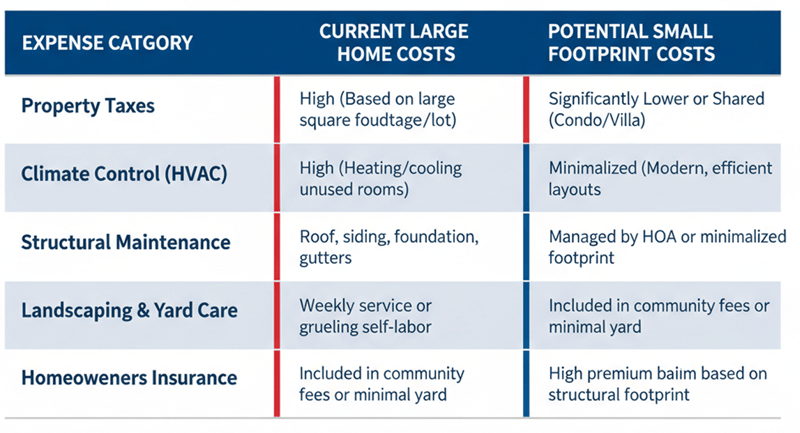
By running a comprehensive audit of these figures over a 12-month trailing period, you can clearly project the exact baseline savings your downsize will yield. For most retirees, this exercise turns an emotional dilemma into a clear-cut, practical decision.
Unlocking Home Equity for Retirement Longevity
For many retirees, the family home represents their largest illiquid asset. Selling a high-value property allows you to convert that locked equity into liquid capital. This capital can be strategically deployed to:
-
Bolster retirement investment portfolios to generate reliable monthly dividend streams.
-
Establish a dedicated healthcare or long-term care cash reserve.
-
Fund experiential goals, such as international travel, buying a secondary vacation condo, or supporting grandchildren's education funds.
Choosing Your Next Environment: Condo, Villa, or Active Adult Community?
Rightsizing means aligning your next living environment perfectly with your physical needs and social aspirations. Consider the three primary avenues for retirement relocation:
-
Low-Maintenance Condominiums
Ideal for those prioritizing urban proximity, maximum security, and a complete "lock-and-leave" lifestyle for frequent travel. Homeowner associations (HOAs) handle all exterior maintenance, common areas, and security details.
-
Single-Story Villas or Townhomes
Perfect for individuals who still want the feeling of an independent home without the physical strain of multi-level staircases. These properties frequently offer small, manageable patio spaces for light gardening without the burden of a sprawling lawn.
-
Active Adult (55+) Communities
Designed for retirees seeking an built-in social infrastructure. These master-planned developments offer shared amenities such as golf courses, fitness centers, clubhouse events, and swimming pools, fostering immediate community integration with peers at the same life stage.
Plan Your Timeline With Confidence
Don't let the logistics cloud your excitement. Download our comprehensive, step-by-step Master Moving Checklist to organize your thoughts and map out your transition perfectly.
Chapter 3: The Room-by-Room Decluttering Matrix
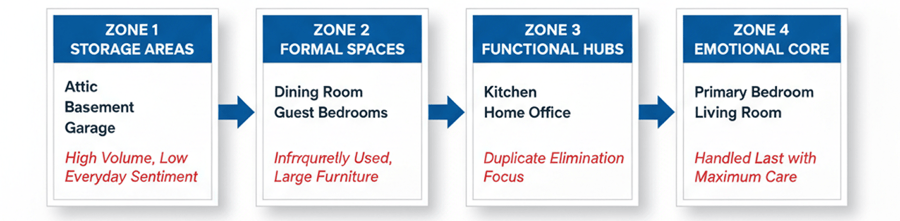
Zone 1: The Attic, Basement, and Garage
These areas represent the "catch-all" spaces where items are stored precisely because they are no longer part of your daily routine. Ironically, while these zones hold the highest volume of items, they often contain the lowest density of daily sentimental value.
-
The 2-Year Rule: If an item has resided in a box in your attic or basement for over two consecutive years without being opened, viewed, or utilized, it is a prime candidate for donation or liquidation.
-
Tools and Equipment: A downsized home will not require riding lawnmowers, industrial extension ladders, or duplicate sets of wrenches. Retain a singular, compact emergency toolkit and liquidate the remainder.
-
Old Documentation: Shred tax documents older than seven years, old utility bills, and outdated medical records. Digitization services can scan essential historical documents into a secure cloud drive, saving physical boxes of paper space.
Zone 2: Guest Bedrooms and Formal Dining Areas
Formal dining rooms and extra bedrooms are often the first spaces to become obsolete when children move out.
-
Furniture Assessment: Measure the dimensions of your future home. Large china cabinets, 12-leaf dining tables, and full guest bedroom sets simply will not fit into a downsized layout. Prioritize pieces that offer multi-functional utility (e.g., a storage ottoman or a drop-leaf table).
-
Linens and Bedding: A home with fewer bedrooms requires fewer sets of sheets, quilts, and towels. Retain two high-quality sets of linens per bed in your new floor plan and donate excess textiles to local animal shelters or community housing initiatives.
Zone 3: The Kitchen and Living Spaces
The kitchen is notoriously the most duplicate-heavy room in any large household.
-
The Rule of Duplicates: You do not need three crockpots, two roasting pans, or a 24-piece setting of everyday dinnerware. Reduce your kitchen inventory to reflect your actual daily lifestyle plus accommodation for a modest number of guests.
-
Media and Books: Huge collections of VHS tapes, DVDs, and CDs take up valuable wall space. Transition to digital streaming services where possible. For sprawling home libraries, select a core collection of your absolute favorite, most formative books to display, and donate the rest to local libraries or schools.
Zone 4: The Deeply Sentimental Core (Closets, Photo Albums, Keepsakes)
Save this zone for last. By the time you reach your personal closets and family mementos, your decision-making muscles will be strengthened, making the emotional choices far easier to handle.
-
Wardrobe Rightsizing: Be realistic about your retirement wardrobe. If you are retiring from a corporate environment, you will likely need far fewer business suits and formal garments. Focus on comfort, versatility, and high-quality seasonal staples.
-
The Photo Dilemma: Decades of physical photographs can fill entire closets. Dedicate time to sorting out blurry shots, duplicates, or photos of landscapes without people in them. For the remaining photos, consider a professional digitizing service that scans them onto a single, secure flash drive or cloud account, preserving your legacy permanently without taking up any physical space.

Chapter 4: The Legacy & Gifting Strategy — Passing Down Memories Properly
The Reality of Modern Inheritances
One of the most challenging realizations for retirees is discovering that their adult children often do not want traditional family heirlooms. Lifestyle preferences have shifted; younger generations frequently prefer minimalist aesthetics, modern functional furniture, and digital media over heavy antique furniture, formal crystal, or extensive silver collections.
Rather than taking this personally, view it as an opportunity to change how you pass down your family's legacy. Gifting items should be a joyful process, not an obligation forced upon the next generation.
Conducting a "Living Legacy" Distribution
Don’t wait for an estate plan to distribute your most meaningful items. Organize a family gathering where your loved ones can choose items that carry genuine meaning for them.
-
Tell the Story: When passing down an item, share its history. Write down the story of where an heirloom came from and tape it securely to the bottom or back of the piece. This contextual history turns an object into a treasured story.
-
Respect the "No": If a family member gently declines an item, accept their choice gracefully. It is far better to sell or donate an object to someone who will actively use it than to force a loved one to store it out of guilt.
Alternative Ways to Preserve History Without the Clutter
If a valuable or sentimental item cannot be kept or passed down, explore creative ways to preserve its essence:
-
Memory Quilts: Transform old sports jerseys, favorite t-shirts, or meaningful fabrics into a single, beautiful patchwork memory quilt.
-
Shadow Boxes: Instead of keeping an entire trunk of military uniforms or wedding attire, frame a few core elements (medals, lace patches, old photos) in a compact, elegant shadow box for your new wall.
-
Digital Memory Books: Take high-resolution photographs of large, unkeepable items (such as childhood art projects or bulky collections) and compile them into a beautiful, thin, professionally bound coffee-table photo book.
Chapter 5: Estate Sales, Donations, & Maximizing Asset Value
Estate Sales vs. Consignment vs. Online Marketplaces
Once you have curated what you are keeping and what your family is inheriting, you will likely be left with a substantial pool of valuable items to liquidate. Choosing the right sales channel ensures you maximize your return with minimal stress.
Estate Sale Companies
Ideal if you have an entire household of high-quality furniture, tools, and decor to clear out at once. Professional estate liquidators handle the pricing, staging, marketing, and crowd management in exchange for a percentage of the total sales (typically 30% to 50%). This is the most efficient, hands-off option for complete liquidation.
Consignment Shops
Best for high-end fashion, fine art, individual antique pieces, or luxury jewelry. Consignment shops display your items in curated showrooms to target specific buyers, splitting the final profit with you once the item sells.
Online Marketplaces (eBay, Facebook Marketplace, Chrono24)
Excellent for niche collectibles, electronics, or specialized tools. While this option yields the highest profit margin because you bypass commissions, it demands the highest amount of personal labor, requiring you to photograph items, write descriptions, answer inquiries, and manage secure shipping or meetups.
Identifying Truly Valuable Antiques vs. Nostalgic Value
It is critical to distinguish between market value and personal value. Items like mid-century modern furniture, solid wood mid-century sets, vintage watches, and fine jewelry continue to hold strong market demand. Conversely, items like 1990s collector plates, mass-produced porcelain dolls, and bulky Victorian reproduction furniture often have very limited resell value today.
Consider hiring a certified appraiser (ISA or ASA accredited) to evaluate signature items early on. This protects you from underpricing rare valuables or wasting time overpricing items with minimal market demand.
Tax-Deductible Donations: Doing Good While Maximizing Write-Offs
Donating your remaining inventory to registered 501(c)(3) charities is an excellent way to support your local community while optimizing your financial return.
-
Itemized Inventory: Keep a detailed, itemized spreadsheet of every single item you donate, noting its condition and fair market value.
-
Receipt Accumulation: Always request a formal donation receipt from the drop-off center.
-
Professional Appraisals for High-Value Donations: Per IRS guidelines, if an individual item or a collection of similar items being donated is valued at over $5,000, you must obtain a qualified independent appraisal to claim the deduction on your tax returns.
📦 Streamline Your Packing Strategy
Moving into a smaller space means your packing must be incredibly intentional. Avoid moving clutter by downloading the official, print-friendly Atlas Van Lines Moving Checklist to keep your sorting completely organized.
Chapter 6: Selecting the Right Partner — Evaluating White-Glove & Specialized Movers
The Importance of Fully Licensed and Insured Movers
A retirement move involves handling items that represent your life's savings and personal history. Entrusting these items to unverified, discount movers introduces unacceptable financial and emotional risks.
Always confirm that your chosen moving company is fully licensed and insured. For interstate relocations, the provider must hold a valid United States Department of Transportation (USDOT) number and a Federal Motor Carrier Safety Administration (FMCSA) registration. Being fully insured guarantees that you are legally protected against structural damage, loss, or transport accidents, giving you complete peace of mind.
What to Expect from a True "White-Glove" Service Experience
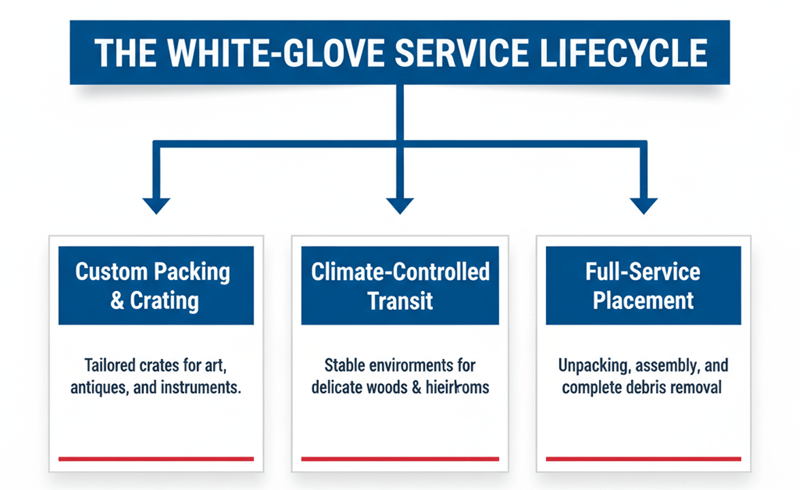
For a premier retirement move, standard curbside pick-up is rarely sufficient. A "white-glove" moving package offers a comprehensive, stress-free relocation experience where professionals handle every piece of manual labor and logistics.
-
Custom Crating for Valuables: Standard cardboard boxes cannot protect delicate grandfather clocks, expensive oil paintings, or fragile heirloom china. White-glove teams build custom wooden crates tailored precisely to the dimensions of your highest-value assets.
-
Climate-Controlled Logistics: Sensitive items—such as vintage wine collections, high-end wooden instruments, or delicate antique veneers—can warp, crack, or degrade when exposed to extreme heat or humidity. Specialized transit vehicles maintain stable internal climates throughout the journey.
-
Full-Service Placement and Setup: Upon arrival at your new home, white-glove specialists don't just drop off boxes in the garage. They unpack every item, assemble furniture pieces, place belongings exactly according to your floor plan design, and completely remove all packing materials and debris from the property before leaving.
Spotting Red Flags in Moving Estimates
When comparing moving quotes, look out for common industry red flags to avoid hidden costs and scams:
-
Extremely Low Estimates: If a quote seems too good to be true, it likely is. Shady operators often provide a artificially low baseline price, only to hold your belongings hostage later for thousands of dollars in unquoted "fees."
-
Refusal to Conduct a Detailed Survey: A reputable moving provider will never give a guaranteed final price without performing an in-person walkthrough or a comprehensive virtual video inventory survey of your home.
-
Demands for Massive Cash Deposits: Professional, licensed moving operations bill you upon delivery or via structured corporate payment systems. Avoid any operator demanding large upfront cash payments to secure your moving date.
Chapter 7: The Master 12-Week Interactive Timeline
To execute a seamless, dignified downsize, use this week-by-week logistical framework to break the process down into simple, highly manageable steps.
Weeks 12 to 10: The Assessment Phase
-
[ ] Audit Your Future Space: Secure blueprints or take detailed physical measurements of every room, doorway, and hallway in your upcoming residence.
-
[ ] Locate Core Documents: Gather all housing deeds, financial portfolios, medical records, and estate plans into a single, highly secure, portable lockbox.
-
[ ] Schedule Professional Consultations: Reach out to estate sale liquidators and licensed moving companies to schedule initial home walkthrough surveys.
Weeks 9 to 7: The Curation Phase
-
[ ] Execute the Room-by-Room Matrix: Tackle the attic, basement, and storage areas first to filter out non-sentimental clutter.
-
[ ] Host the Living Legacy Distribution: Invite your family members over to claim meaningful heirlooms and record the family stories attached to them.
-
[ ] Finalize Your Moving Partner: Review your options, select your professional moving provider, and lock in your guaranteed move date.
Weeks 6 to 4: The Liquidation Phase
-
[ ] Host Your Estate Sale: Execute your planned liquidation event or hand over your curated items to consignment professionals.
-
[ ] Digitize Physical Media: Send your boxes of old family photos, cassettes, and documents to a specialized scanning facility for digital conversion.
-
[ ] Initiate Address Changes: File an official change of address with the United States Postal Service (USPS) and update your details with the Social Security Administration, banks, and insurance providers.
Weeks 3 to 2: The Final Coordination Phase
-
[ ] Coordinate Utility Transitions: Schedule the shutoff dates for water, gas, electricity, and internet at your current home, and ensure they are active at your new location the day before you arrive.
-
[ ] Measure Furniture Paths Again: Double-check that your large, kept items can safely navigate the hallways and elevator shafts of your downsized property.
-
[ ] Pack a Personal Essentials Bag: Set aside a 72-hour suitcase containing daily medications, basic toiletries, a few changes of comfortable clothing, phone chargers, and core financial documents.
Moving Week & Moving Day: Execution
-
[ ] Oversee the Pack-Out: Let your white-glove packing crew handle the secure crating and labeling of your items. Your role is simply to answer questions and clarify room placements.
-
[ ] Perform a Final Walkthrough: Check every single closet, cabinet, crawlspace, and outdoor shed one last time before locking up the family home.
-
[ ] Welcome Your Belongings: Arrive at your new home ahead of the moving truck to guide the placement of furniture and begin your next chapter with confidence.
Chapter 8: Designing and Settling into Your New Sanctuary
Prioritizing Lighting, Flow, and Accessibility
Transitioning to a downsized footprint is an excellent opportunity to design a space focused entirely on comfort and future-focused accessibility.
-
Maximize Natural Light: Smaller spaces look significantly larger and feel more uplifting when filled with natural light. Choose sheer, minimal window treatments rather than heavy, dark drapery.
-
Ensure Clear Walkways: Arrange your furniture pieces to provide wide, unhindered pathways through every room. This open layout prevents an overcrowded look and ensures safety as you grow older.
-
Incorporate Smart Lighting: Install motion-activated baseboard lighting in hallways and bathrooms to make navigating your new home at night safe and easy.
Unpacking the "Sentimental Anchors" First
The quickest way to make an unfamiliar house feel like home is to immediately unpack your "sentimental anchors."
-
The Living Room Setup: Arrange your absolute favorite books, art pieces, and family photographs on your primary shelving units immediately on day one.
-
The Primary Bedroom Sanctuary: Use your most comfortable, familiar bedding and curtains right away. Surrounding yourself with these familiar sights and textures provides immediate psychological comfort, helping you adjust to the new environment and sleep soundly.
Overcoming Transitional Loneliness and Integrating into the Community
It is entirely normal to feel a wave of displacement or nostalgia during your first few weeks in a new home. Building a new routine is the best way to move past this transition period:
-
Establish a Daily Routine: Find a local morning coffee shop, a nearby library branch, or a walking path to visit at the same time each day to ground yourself in your new neighborhood.
-
Leverage Local Classes and Clubs: Join community fitness groups, book clubs, card groups, or volunteer organizations to quickly build a supportive social circle of like-minded peers.
Frequently Asked Questions
How do I figure out what will fit into my new downsized home?
The most accurate method is to create a physical or digital floor plan map using the exact dimensions of your next home. Measure your existing furniture pieces and plot them onto the layout. Be sure to account for clearance around doorways, windows, and heaters, and pass down or liquidate any items that disrupt a clean, safe walking path.
What is the most respectful way to handle items my children do not want?
Remember that a choice to decline an item is not a rejection of your family history or love. It simply reflects changing lifestyle design preferences. Reframe the situation by offering the items to extended family members, selling them to collectors who will cherish them, or donating them to meaningful charities where they will find a helpful second life.
How do white-glove moving services handle rare collectibles or fine art?
White-glove movers treat delicate valuables with specialized protocols. This includes building custom-fitted wooden crates lined with shock-absorbent insulation, utilizing climate-controlled transport vehicles to prevent temperature damage, and using specialized lifting techniques to move heavy or delicate items safely.
Is it better to host an estate sale myself or hire a professional?
Hiring a professional estate liquidation company is highly recommended. While they take a percentage commission, they manage everything—including sorting, pricing, permits, targeted marketing, and post-sale cleanouts. This completely removes the immense physical and emotional stress of managing a sale yourself.
How long does the entire retirement downsizing process typically take?
For a typical multi-bedroom family home, the complete journey takes roughly 8 to 12 weeks. This structured timeline gives you ample time to sort through sentimental belongings without feeling rushed, host liquidation sales, and secure a premium moving company during peak operational seasons.
Transitioning to a simpler, more intentional lifestyle should be liberating, not stressful. Let Atlas Van Lines handle the complex logistics with the care, dignity, and professionalism you deserve.
👉 Download the Ultimate Moving Checklist to kickstart your planning today, or click below to request your free, personalized moving quote!